How contact-free, compressed-air-free spray technology helps the food industry address cost pressures, hygiene
requirements and the convenience boom
Rising energy and raw material prices are forcing food manufacturers to put their processes to the test. In addition, a dynamic convenience market and demanding auditors require the highest levels of flexibility and hygiene. One lever that has often been underestimated lies in the application of various agents, such as oils or water. Conventional methods, such as twin-fluid nozzles or contact oilers, are increasingly reaching their technological and economic limits in many applications. One answer to these challenges is spray systems that apply media with precision, without compressed air and without contact. They meter the media precisely and without contact, significantly reducing the consumption of oils and release agents. This enables faster product changeovers, clean production environments and consistent, repeatable application quality.
Whether baked goods, confectionery, sausages and meat products or convenience products: industrial food producers today operate amid substantial cost increases and shifting market trends. Consumers are increasingly choosing convenience food, while also demanding healthier, reduced-fat recipes and sustainable production (zero waste). For manufacturers, shorter product life cycles mean one thing above all: they have to retool their production lines more frequently and quickly.
In this demanding environment, process steps that were long regarded as a mere necessity are coming into focus. One of them is media application. Applying oils, release agents, water or liquid egg precisely to dough pieces, baking moulds or trays has a decisive influence on the final product quality. Nevertheless, many businesses still use conventional processes that can result in overspray losses and consequential costs.
The physical and hygienic limitations of the status quo
Traditionally, media are generally applied using one of two methods: contact oilers (such as sponge or brush systems) or compressed-air-operated twin-fluid nozzles. Both methods have systemic weaknesses. Contact oilers transfer the medium directly through physical contact, often in continuous ovens. The resulting friction inevitably causes wear to the plastics or felts used. In the worst case, this wear ends up on the product or conveyor belt. Independent auditors carrying out equipment certifications are now highly critical of these systems. In addition, the sponges harbour bacteria uncontrollably, necessitating regular, costly replacement.
The alternative, application via a twin-fluid nozzle, uses compressed air to atomise the liquid medium. For physical reasons, this produces a very broad range of droplet sizes. A considerable proportion of these droplets are so small that they do not settle on the target surface but remain suspended in the air. This so-called overspray forms a fine mist that spreads extensively throughout the production environment. The consequences are far-reaching: the mist contaminates adjacent machines, forces companies to clean continuously and makes floors slippery, increasing the risk of accidents. To purify the ambient air, manufacturers operate energy-intensive extraction systems whose filters must be replaced regularly. Above all, however, overspray represents a pure waste of raw materials, as a significant proportion of the medium is lost to the surroundings instead of being available to the production process.
High frequency instead of compressed air: the solution lies in the valve
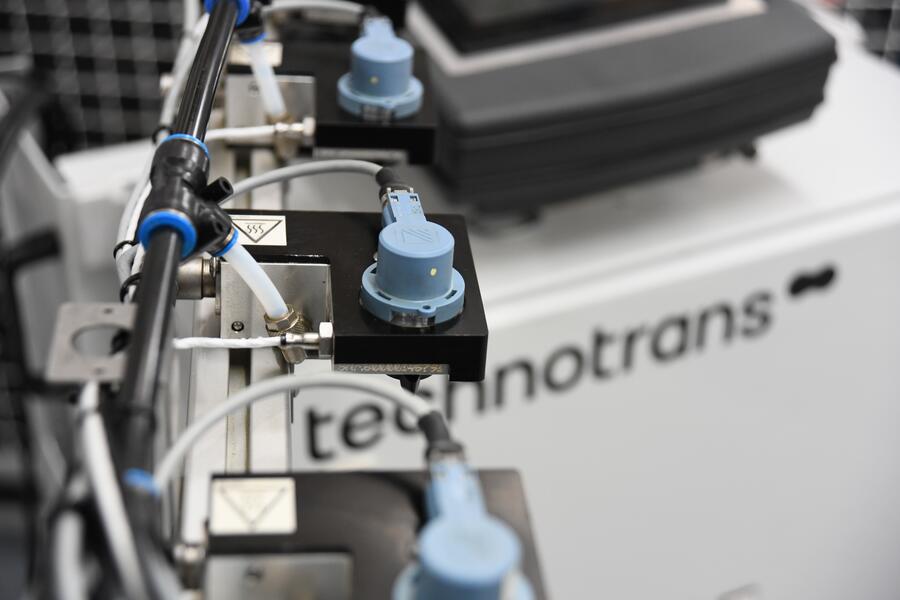
The thermal management and fluid technology specialist technotrans has developed a process that operates entirely without compressed air. At the heart of the technotrans solution is a specially designed, high-frequency pulsed valve. An integrated piston, driven by an electromagnetic field, opens a precisely defined aperture within milliseconds. The medium is held at constant pressure in the piston chamber. As it flows through the aperture towards the flat-fan nozzle, the liquid is atomised solely by the applied pressure and the nozzle geometry – entirely without an air stream. The system controls the dosage exclusively via the valve’s pulse frequency and opening time. The result is a homogeneous, extremely precise spray pattern without microscopic suspended particles.
Viscosity management through direct temperature control at the nozzle
Food manufacturers process media with a wide range of flow properties. The viscosity of higher-viscosity liquids in particular, such as rapeseed oil, sunflower oil or special release agents, varies considerably with the ambient temperature – for example, between cold winter days and operation right next to a hot oven. To ensure consistently high spray quality, technotrans valves have an integrated heating cartridge and temperature sensor at the nozzle. Targeted heating reliably reduces the viscosity of the medium. This also makes it possible to spray viscous media finely and homogeneously, largely independently of the ambient temperature. This approach offers a further key benefit for food safety and hygiene: the valve can be heated to above 70 degrees Celsius. The temperature treatment supports hygiene at this point in the system.
Flexibility and ease of operation amid a shortage of skilled workers
The convenience market calls for frequent product changeovers. A system may be producing goods requiring a fine application of water in the morning, then processing baked goods that require different release agents at midday. To minimise changeover times, technotrans can, on request, integrate its technology into fully mobile, movable units (Hygienic Design). When changing orders, users can simply move the system out of the baking line or production line for retooling, maintenance or cleaning in a separate washroom. The systems meet protection classes up to IP69 and withstand alkaline foam cleaners and high-pressure water jets.
At the same time, the technology helps address the acute shortage of skilled workers. Operators do not need in-depth technical knowledge. The system stores up to 255 individual recipes with precise parameters, which can be retrieved at the touch of a button. For fully automated smart factories, the spray systems can also be seamlessly integrated into higher-level control systems via PROFINET or PROFIBUS. The system then automatically retrieves the recipe required for the current production run.
The compressed-air-free technology also demonstrates its benefits in complex, specialised applications. In the confectionery industry, customised technotrans systems temperature-control the entire conveying route, from the mixing unit to the nozzle, to spray wax-containing media without crystallisation. In the meat industry, meanwhile, where schnitzels lying in a random arrangement on the conveyor are coated, a dedicated recovery system captures the unavoidable overspray at the edges, filters the medium and returns it to the process.
Conclusion: Faster return on investment
Switching to compressed-air-free, contactless spray technology is no longer merely a minor process improvement; it is a strategic lever for competitiveness. The combined savings speak for themselves: companies significantly reduce their media consumption, operate entirely without compressed air and noticeably lower the energy required for extraction and cleaning. When the drastically reduced cleaning and maintenance effort is also taken into account, the investment can pay for itself after only a short period of operation, depending on the application and utilisation. The shift towards precision oil application is therefore one building block on the way to more efficient food production.
Further information: www.technotrans.com