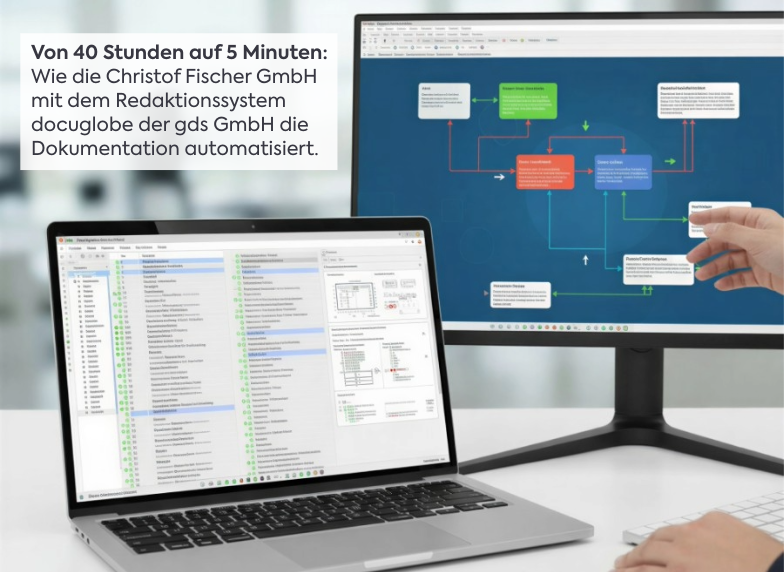
• Christof Fischer GmbH has automated the creation of its operating manuals using the docuglobe editorial system. Structured data and intelligent workflows replace time-consuming manual documentation.
• Instead of compiling documentation manually, Christof Fischer automatically generates plant-specific operating manuals from structured data.
• Automation does not replace technical writers – it transforms their role. At Christof Fischer, technical writers now focus on content structure, modularization, and quality, while docuglobe automatically generates the documentation.
• Many companies already have the data needed for automated documentation – they just aren't using it consistently yet. Christof Fischer's success story shows how to take the first steps toward automated technical documentation.
Christof Fischer GmbH has fundamentally transformed the way technical documentation is created. By consistently leveraging structured data, modular content, and automated workflows, plant-specific operating manuals are now generated almost entirely automatically. This customer success story demonstrates how the seamless integration of product structures, configurator data, and the docuglobe editorial system leads to significantly greater efficiency, more consistent documentation, and a substantial reduction in the workload of technical writers.
The situation at Christof Fischer GmbH
As part of Fischer Kälte-Klima group, Christof Fischer GmbH is specialized in refrigeration, air-conditioning, and systems engineering solutions. With several hundred employees, more than 5,000 customers, and an extensive portfolio of modular systems, the company operates in an environment that is characterized by an extensive variety of configurations and complex technical requirements.
Although this diversity is a critical success driver, it also creates significant challenges for the technical documentation team. After all, every single system leaving the factory is configured to the specific requirements of the customer and, therefore, varies in terms of its design, components, and functions.
The modular character of the products, which plays an important role during the design and project planning phases, carries through into the documentation process.
This close interconnection between the configuration-based product architecture and the accompanying documentation turned out to be the key prerequisite not only for optimizing the documentation process but also for largely automating it.
When documentation becomes a challenge
No two systems are alike. The same is true for their operating instructions.
However, what sounds obvious has now become a real challenge over the years, since with every new system, the documentation team essentially had to start from scratch: Content had to be compiled, variants checked, and technical data transferred by hand.
However, the key question always remained the same: What exactly should be included in the instructions and what can be omitted?
The amount of work kept growing. On average, the technical writers needed approximately 40 hours to complete a single operating manual.
“For us, the situation was always the same: Every manual had to be individually compiled. The entire process was very time-consuming, prone to errors, and hardly scalable,” explains Anke Hoffmann, technical writer at Christof Fischer GmbH.
The turning point: a simple, yet radical question
Instead of further optimizing the existing process, the team came up with a very fundamental question:
Why are we producing our documents manually when the underlying data has been digitally available throughout the company for a long time now?
This train of thought changed everything. For the first time ever, the goal was not to speed up the writing process, but to completely rethink the entire documentation approach.
From content writing to content assembly
The new method was clear: Rather than being written manually, documents would be generated automatically with docuglobe.
“Automation does not start with the content management system, but rather with the structure of the content and the quality of the data,” says Christian Paul, product manager for docuglobe at gds GmbH.
However, as a first step, this required the necessary groundwork to be put in place.
Content was systematically broken down into modules, a master document was created, and every piece of information was captured and carefully organized. This master document represents the “sum of all possibilities” and includes every piece of information that may be relevant for the various system variants.
As to which modules will actually be used at a later stage is no longer decided by the writers on a case-by-case basis; instead a clearly defined set of rules does that.
Data as the starting point for the documentation process
However, the real key to automation is not found in the documentation process per se but rather in the upstream systems.
At Christof Fischer GmbH, a bespoke configurator provides all of the relevant information about a system – from its technical data up to any specific features. This data is provided in a structured format, for example as JSON or CSV files, or associated graphics and diagrams.
“The most important step was to format this data so that it could be processed directly within the content management system,” explains Christian Paul. “That’s when true automation becomes possible.”
A new workflow is born
The entire documentation process was redesigned on this basis.
Today, the data flows from the configurator directly into the docuglobe system where the content is then automatically filtered, assembled, and brought into the right format.
As a result, a system-specific operating manual can be created from a central master document in a very short time.
“We have basically turned the process upside down,” explains Anke Hoffmann. “In the past, we used to track down and compile the content. Today, we define the rules and then the system produces the corresponding documents based on them.”
The result: higher efficiency, improved quality, and a reduced workload
The effects of this new method are clearly evident.
Instead of taking several days, an instruction manual can be produced in just a few minutes now. To be precise, the time required was reduced from around 40 hours to under 5 minutes.
“Obviously, this saves an enormous amount of time,” says Anke Hoffmann. “However, the quality is of equal importance. The resulting documents are consistent and perfectly adapted to the respective system.”
All of this also has a direct effect on the after-sales service: There are fewer inquiries from customers, as the information provided is more accurate and very comprehensive.
The new role of the technical writing team
Contrary to what might be expected, automation has not made the technical writers redundant. Instead, it has transformed their role.
“The team members are now content architects,” explains Christian Paul. “They define the structures, rules, and standards, while the system handles the actual creation.”
Anke Hoffmann confirms this point of view: “There is a much stronger focus on the quality and structure of our content. That’s quite different from how it used to be.”
What it takes to succeed
The success story of Christof Fischer illustrates the tremendous potential that is inherent in the automation of the technical documentation process, and it also shows that this strategy is viable for other companies too.
What matters most is not so much the starting point but rather the overall approach: Structured data, clear processes, and a well-conceived modular approach provide the basis for successful implementation.
“Many companies already sit on the necessary data. They just don’t use them consistently for their documentation process,” explains Christian Paul. “This is precisely where the greatest leverage can be found.”
Christof Fischer GmbH also developed this new approach step by step. The design, IT, and technical writing teams collaborated closely with one another to harness the existing data and set up the necessary framework.
“You don’t need to automate absolutely everything straight away,” adds Anke Hoffmann. “What is important is to get going and to review your own processes. Often, simply taking the first few steps already brings about noticeable improvements.”
This shows that: Automation is not a one-time large-scale project, but rather an ongoing development process that can be adapted to a company’s specific requirements.
Focusing on the future
For Christof Fischer GmbH, this project is an important milestone, but it is not the end of the story.
Future plans include the integration of additional data sources and the continued expansion of the automation process. In addition, the use of AI for cleaning up and organizing data will also play an important role.
The goal remains clear: to create a seamless digital chain of information in which new documentation is automatically generated using the existing data.
Conclusion
The project at Christof Fischer GmbH shows that the automation of technical documentation workflows offers much more than just efficiency gains.
Instead, it transforms the entire process from the collection of data to the finished manual.
What matters most is not the technology alone, but rather the consistent use of structured data and clearly defined processes. This strategy transforms the content management system into a tool for true automation.
About the user
[CF] SYSTEMS is a business unit of Fischer Kälte-Klima with a specialization in bespoke system solutions for commercial and industrial refrigeration and air-conditioning needs.
With 26 sites in Germany, Switzerland, and Denmark, more than 7,500 m² of production space at its Kernen site near Stuttgart, its own in-house shipping and transport network, and numerous regional contacts, the company expertly handles projects from the planning stage to the after-sales phase.
The modular [CF] CO2RE series from [CF] Systems is a high-performance CO₂ composite system that is specifically designed for challenging applications in the food retail, industrial, and logistics sectors.